
1. Clarify and Purify Fermentation Broth to Raise Product Yield and Purity
For fermented food lines such as starch sugar, monosodium glutamate and citric acid, separation performance directly shapes output and product quality. Fermentation broth carries mycelia, soluble protein and starch residues. Traditional filtration works slowly and easily traps target materials. This drags down yield, hurts final quality, and creates heavy burdens for downstream high-concentration wastewater treatment. Our dedicated PAM for starch fermentation and food additives optimizes the whole production workflow. It supports fermentation broth clarification, by-product recovery, high-strength wastewater pre-treatment and sludge reduction. All these functions help factories lift purity, earn extra profits and control costs.
When you add this agent at saccharification and broth extraction stages, its polymer chains capture impurities via adsorption and bridging. It binds mycelia, insoluble protein and starch fines into dense flocs and speeds up solid-liquid separation. Compared with natural settling or standard filtration, this method cuts clarification time and separates impurities more thoroughly. It also reduces loss of valuable substances and improves product purity and light transmittance.
In starch sugar production, clarified saccharified liquid holds fewer impurities. This eases loads for subsequent ion exchange and decoloring, and stabilizes sugar quality. For MSG and lysine fermentation, cleaner broth delivers higher extraction yield. In short, manufacturers get more finished goods from the same raw materials.
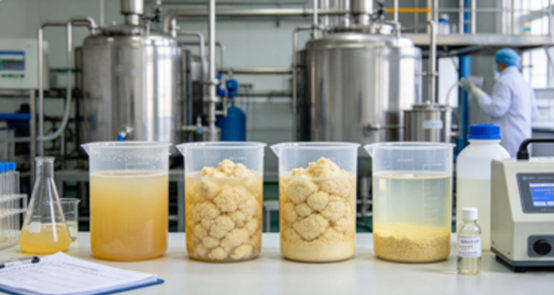
2. Recover Protein By-products via Flocculation to Turn Waste into Profit
Starch and fermentation processes generate yellow serofluid and waste mycelial liquid. These streams contain usable plant protein and bacterial protein. Direct discharge wastes valuable resources and spikes COD levels in wastewater. Once you dose the custom PAM, protein particles and microbial cells flocculate rapidly and settle into compact aggregates.
After dewatering, the collected protein cake serves as feed additive or organic fertilizer raw material. Waste pollutants turn into an extra revenue stream. Besides, flocculation beats dissolved air flotation on recovery rate and capital cost. It also lowers organic pollution in wastewater. One investment brings two clear benefits, so large-scale starch and fermentation plants see remarkable profit gains.
3. Pre-treat High-strength Wastewater to Protect Downstream Treatment Units
Wastewater from starch fermentation carries high COD, abundant suspended solids and unstable water quality. If it flows straight into anaerobic and aerobic tanks, it shocks microbial communities and triggers unstable effluent readings. For this reason, operators add custom PAM together with coagulants in pre-treatment. The combination quickly flocs suspended solids, colloids and most non-soluble COD, and lightens pollutant loads for biochemical systems.
As a result, downstream biology runs more steadily and handles inlet fluctuations better. Effluent stays compliant. This setup also cuts aeration power consumption and chemical use in advanced treatment, and lowers overall operation costs. During peak production or sudden inlet concentration surges, pre-flocculation works as a reliable buffer. Operators do not need frequent, drastic process adjustments.
4. Dewater and Reduce Fermentation Sludge to Trim Disposal Expenses
Wastewater treatment generates fermentation sludge and biochemical sludge. This sludge holds rich organic matter, sticks easily and retains high moisture, which makes dewatering tough and pushes up disposal fees. Cationic custom PAM conditions sludge and rearranges its surface structure. It releases bound water trapped inside sludge particles and greatly improves dewatering efficiency.
When paired with plate-and-frame or belt filter presses, the treated sludge forms firm, low-moisture cakes. Sludge volume shrinks by more than half, and transport and disposal costs drop sharply. Based on its composition, dried sludge can turn into organic fertilizer or seedling substrate. This extra reuse path further cuts waste-handling spending.
5. Fit Diverse Production Lines While Safeguarding Product Quality
This PAM works across a wide range of production scenarios. It suits corn starch, cassava starch and starch sugar (glucose, maltose, high-fructose syrup) lines. It also matches fermentation food additives including MSG, citric acid, lysine and xanthan gum. It reacts mildly and keeps active components intact in fermentation broth. It introduces no off-flavors or foreign contaminants, and meets hygiene standards for food manufacturing. Moreover, it fits existing extraction tanks, sedimentation tanks and filter presses directly. Factories can launch this solution fast without major line retrofits.
6. Low Dosage, Simple Operation and Favorable Long-term ROI
Many food producers worry that specialty chemicals demand tricky workflows and high running costs. This product removes those barriers. Staff only dissolve the powder in room-temperature water at the set ratio, then feed the solution quantitatively with metering pumps. You can tweak dosing rates based on feed concentration and water quality. Ordinary line workers master the routine after brief training, with no dedicated specialist required.
Besides, the chemical consumption stays minimal. You only need several to over ten grams of PAM for one ton of feed liquid or wastewater. When you count higher product yield, revenue from recycled by-products and saved environmental treatment costs, the return on investment stands out. It fits small, medium and large manufacturers alike.